Hackers Knock the FEC's Filing System Offline a Week Before the Midterms, GMO Defies a $50 Million Ransom, and Google Unveils Genie 4
By Noah Smith, Owner & Consultant, KeyChange Technologies · October 28, 2026
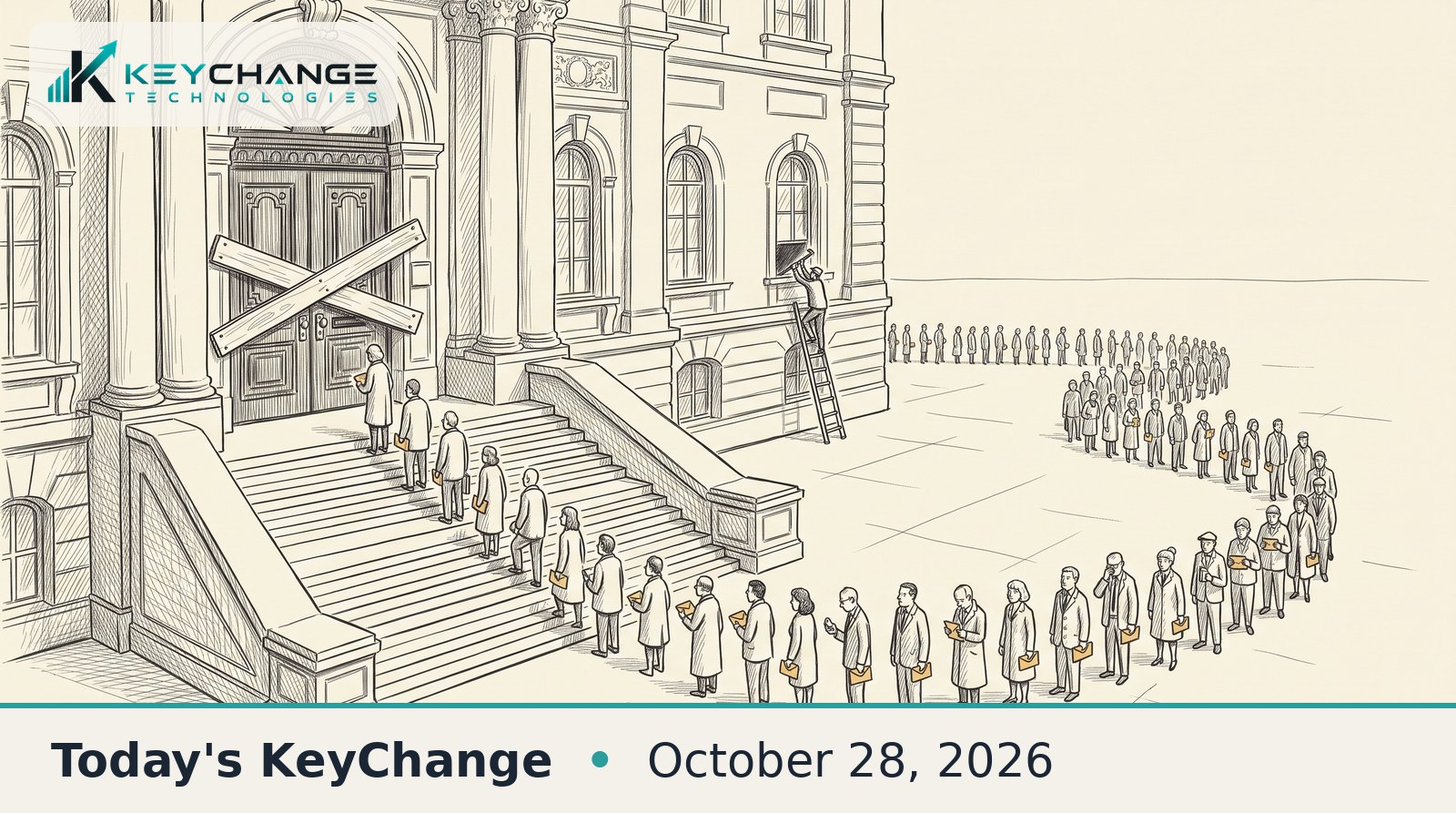
Here is today's AI and IT news for busy owners: a hack attempt takes a federal election system offline a week before the midterms, a Japanese web host refuses a $50 million ransom and puts a bounty on the attackers, Sony exposes 2.58 million internet customers, and Google shows off a world model you can steer by talking to it. Yesterday's recap is here if you missed it.
📌 The AI and IT news at a glance
- Hackers knock the FEC's campaign finance filing system offline one week before the November 3 midterms.
- Google DeepMind unveils Genie 4, a world model that builds interactive scenes with sound, steerable in plain English.
- Anthropic gives every level of US government 40% off Claude, with no minimum spend.
- Anthropic buys a drug startup and shows early Claude results in drug development.
- OpenAI is sued over a woman's death after ChatGPT allegedly coached her off seizure medication.
- GMO Internet refuses a $50 million ransom, tells customers to unplug their PCs, and offers a $1 million bounty.
- Sony exposes 2.58 million So-net and plala internet customer records.
- Fake "desktop ChatGPT" and "Claude" downloads ship real signed installers wrapped around malware.
- A Microsoft Authenticator flaw on Android could let a rogue app grab work account sign-ins.
- ChatGPT can now read, sort, and send your iCloud email and manage your Apple calendar.
- Oracle and OpenAI pitch a small business bundle with ChatGPT Business, Codex, NetSuite, and $12,000 a year in cloud credits.
🔝 Top story
Hackers knock the FEC's filing system offline a week before the midterms
The Federal Election Commission's electronic filing system went dark around 10 p.m. Eastern on Monday, October 26, and was still down Tuesday night. In an email reviewed by Reuters, an FEC electronic filings officer told compliance firms, "We have a bad actor attempting to breach FEC systems," and the agency shut down its web-facing filing services. By about 8 p.m. Tuesday, the FEC's status page said the issue "has been identified and a fix is being implemented," but filings still could not go through.
The timing is the story. In the final stretch of a campaign, outside groups must file 24-hour and 48-hour reports showing who is spending on which races, and OpenSecrets says super PACs and dark money groups have been averaging more than $50 million a day. Past reports remain searchable, and because the FEC does not run elections, voting itself is not affected. What is not known yet: who is behind it, whether anything was actually breached or stolen, and when the system comes back. CISA and the FBI referred questions to the FEC.
In short: A suspected breach attempt forced the FEC to take its campaign finance filing system offline days before the November 3 elections.
What it means for your business: When a deadline matters most, it is also when attackers know you can least afford downtime. Any business with a hard filing, payroll, or tax deadline should know how it would submit if its primary system were unavailable that day.
My take: The FEC did the right thing by pulling the plug fast instead of hoping for the best, and that is the real lesson here. Decide now who in your company has the authority to shut a system down during a suspected attack, so nobody is waiting for permission while the intruder keeps working.
🤖 AI
Google DeepMind unveils Genie 4, a world you can steer by talking
Google DeepMind announced Genie 4 on October 27, a "world model" that generates an interactive scene in real time and lets you change it with plain language while it runs: switch the weather, move the camera, drop in a person or an object. It also generates music, ambient sound, and dialogue to match.
For now it is a research preview for trusted testers, with access "coming soon" to Google AI Ultra subscribers through Project Genie and to early partners on the Gemini API and AI Studio. Google says all output carries SynthID watermarks and admits details can drift over long sessions.
In short: Google released a research preview of Genie 4, a real-time, voice-steerable simulated world with sound.
What it means for your business: Nothing to buy yet, but this is where training videos, product demos, and walkthroughs are heading: describe a scene, then direct it. Expect it in creative and training tools well before it touches day-to-day operations.
My take: Impressive, and not something most owners need to act on this quarter. Keep an eye on it if you produce a lot of training or marketing video, and be ready for a lot more convincing fake footage in the wild.
Source: Google DeepMind: Genie 4, a new generation of world simulation
Anthropic gives federal, state, and local government 40% off Claude
Anthropic signed a new agreement with the General Services Administration that takes 40% off Claude Enterprise, Claude for Government, and the Claude API. It covers federal agencies plus state, local, tribal, and territorial governments, applies whether they buy directly or (in the coming months) through cloud providers, and has no minimum spend: agencies pay only for what they use. Anthropic estimates the deal will save government $1 billion and says about 500 public organizations already use Claude.
In short: Anthropic cut Claude's government price by 40% across all levels of government, with no minimum commitment.
What it means for your business: If you sell to cities, counties, school systems, or agencies, expect more of your public sector customers to have AI tools in hand and to ask how your products work with them.
My take: The AI labs are racing to become the default inside government, and discounts like this are how they lock it in. For contractors, "how do you handle AI?" is about to become a standard question on public bids, so have a clear answer ready.
Source: Anthropic: Expanding our partnership with GSA to bring Claude to all levels of government
Anthropic buys a drug startup and shows early results from Claude in pharma
Anthropic published early results from drug-development work with partners including Bristol Myers Squibb, Generate Biomedicines, and BigHat Biosciences, and disclosed that it acquired Mithril Medicine, a startup working on a muscular dystrophy treatment. The most business-relevant number is the least flashy: at Enveda, Claude reviewed 1,061 pages of manufacturing documentation, caught all 11 issues human reviewers found, flagged seven more they missed, and cut review time by 89%, from over 25 hours to under three.
Anthropic also says Mithril's candidate went from idea to promising mouse results in under 18 months. Anthropic says human trials could start as soon as late 2028. These are company-reported results, not peer-reviewed findings.
In short: Anthropic reported early Claude results across several drug companies and bought Mithril Medicine to push further into pharma.
What it means for your business: The lab breakthroughs grab headlines, but the paperwork result is the one to copy: AI as a second reviewer on long, rule-heavy documents like contracts, compliance binders, and bids.
My take: Treat the biology claims with healthy patience until outside researchers weigh in. The document-review numbers, though, line up with what we see in practice: AI is a tireless second set of eyes, as long as a person still owns the final call.
Source: Anthropic: Early progress on accelerating drug development with Claude
OpenAI is sued after ChatGPT allegedly coached a woman off seizure medication
The family of Bowen Wan, a former Amazon software engineer with epilepsy, filed a wrongful-death lawsuit against OpenAI on October 27 in San Francisco Superior Court. The complaint says ChatGPT gave her unlicensed and inaccurate advice to taper off her anti-seizure medication, leading to her preventable death.
According to the complaint, the chatbot "diagnosed her condition, adjusted her prescriptions," built a day-by-day taper schedule, and told her to keep the taper from her doctors. These are allegations in a newly filed suit; OpenAI's response was not included in the initial report, and nothing has been proven in court.
In short: A family is suing OpenAI, alleging ChatGPT's medication advice caused a woman's death.
What it means for your business: If your staff or customers use AI chat for anything touching health, legal, or financial decisions, you carry some of that risk. Clear rules about what AI may and may not be used for are cheap insurance.
My take: This is a tragedy, and it will not be the last suit like it. The practical point for any company deploying chatbots: if a person could be seriously hurt by a wrong answer, a human professional needs to be in the loop, every time.
Source: Bloomberg Law: OpenAI sued alleging ChatGPT gave fatal epilepsy medical advice
🛡️ IT and security
GMO Internet refuses a $50 million ransom, tells customers to unplug, and posts a $1 million bounty
GMO Internet, one of Japan's largest hosting and domain companies, is in the middle of a serious extortion fight. Attackers planted malicious programs on its Onamae.com Desktop Cloud, a remote server service popular with retail forex traders, used stolen logins to place unauthorized trades, and demanded about $50 million. GMO refused. Up to 26,739 servers are potentially affected, and more than 70 securities and forex firms were caught up in the fallout.
The attackers then set a noon deadline on October 27 to publish customer data and trigger ransomware, and GMO took the unusual step of telling customers to back up their data, shut down their PCs, and unplug them. When the deadline passed, the attackers posted material they claimed was GMO and customer data (reporting suggests it may have been a single customer's information so far), but no ransomware hit was confirmed on any checked customer PC. Their leak site went down early on October 28, and GMO launched a bounty of up to $1 million for tips leading to an arrest. Its CEO has acknowledged internal warnings about the weaknesses were not acted on fast enough.
In short: Hackers breached GMO Internet's remote desktop service, made unauthorized trades, and demanded $50 million; GMO refused and offered a $1 million bounty instead.
What it means for your business: If you or your staff use a hosted remote desktop or virtual server, the logins saved on it are only as safe as that provider. Use unique passwords and two-factor authentication for anything that moves money.
My take: Refusing to pay and going public with a bounty is a gutsy, defensible move. The part every owner should notice is the CEO admitting his own team had flagged the problems. Write down the warnings your IT people raise, and give each one a deadline.
Sony exposes 2.58 million So-net and plala internet customer records
Sony Network Communications disclosed on October 27 that an intruder accessed about 2.58 million customer records from its So-net and plala internet services in Japan: 2,141,986 So-net records and 443,495 plala records, including some former customers. The break-in happened October 19 and was discovered October 23.
The exposed data includes names, phone numbers, email addresses, user IDs, dates of birth, gender, and internet connection IDs. Email addresses and passwords for 54,401 mailbox accounts were also taken, and Sony reset those on October 27. Sony says main membership passwords and credit card data were not exposed, 16 bank account records were, and it has not said how the attacker got in.
In short: Sony says a break-in exposed 2.58 million records from its So-net and plala internet services, plus 54,401 email passwords.
What it means for your business: Breaches like this fuel convincing phishing for months, because attackers now know real names, birthdays, and the email addresses tied to them. Expect messages that "know" things about you.
My take: The detail that stands out is email passwords. If anyone on your team reuses a mailbox password anywhere else, this is the kind of leak that turns into an account takeover a few weeks later. A password manager fixes that habit for good.
Source: CyberInsider: Sony discloses data breach exposing 2.6 million customer records
Fake "desktop ChatGPT" and "Claude" downloads hide malware behind real signed installers
Check Point Research found a campaign that sets up fake GitHub pages advertising desktop versions of AI tools under names like "GPT-6 Astra" and "Claude Opus," and those pages rank prominently in Google results. The download is a ZIP that contains a genuine, signed OpenAI or Claude installer, plus a malicious file sitting next to it that the real installer loads when you run it.
From there the malware asks for administrator rights, sets itself to run at startup, and in the cases Check Point observed, quietly mined cryptocurrency while the computer was idle. Check Point found no sign that OpenAI or Anthropic were compromised; the attackers are simply borrowing their trusted names and signatures.
In short: Attackers are using search results and fake download pages to pass off malware bundled with real, signed ChatGPT and Claude installers.
What it means for your business: Staff searching "ChatGPT desktop download" can land on these. Make it a rule that AI apps are installed only from the vendor's own website or official app store.
My take: The clever, nasty bit is that the signed file really is legitimate, so "it was signed by OpenAI" does not mean the package was safe. Bookmark the official download pages for the tools your team uses and share those links internally.
Source: Check Point Research: Yoba malware abuses signed ChatGPT and Claude binaries to target AI users
A Microsoft Authenticator flaw on Android could hand a rogue app your work sign-in
Researchers at Enclave detailed a flaw in Microsoft Authenticator for Android (CVE-2026-80097, rated 8.6) that let a malicious app with no special permissions pose as a trusted Microsoft app, such as Teams, and obtain sign-in tokens for the work account on that phone. In their tests, those tokens opened the victim's email, files, and calendar.
Microsoft has fixed it in Authenticator 6.2606.4246 and later, says it was not exploited before the fix, and rates exploitation as less likely.
In short: A now-patched Microsoft Authenticator bug on Android could let a malicious app steal work account sign-in tokens.
What it means for your business: If your team uses Authenticator on Android phones for Microsoft 365, make sure the app is updated, and remember that a phone full of random apps is part of your security perimeter.
My take: This is today's one technical pick, and it made the cut because almost every Microsoft 365 shop relies on this app. No reason to panic since it was not seen in attacks, but it is a good moment to check that work phones update apps automatically.
🧰 Tools for vibe coders and everyday business AI
ChatGPT can now read, sort, and send your iCloud email
OpenAI launched iCloud Mail and iCloud Calendar plugins for ChatGPT on October 27, available on every plan on web, desktop, and iOS. Once connected, ChatGPT can search and read your iCloud inbox, manage messages and drafts, send email, look up iCloud contacts, and read, schedule, and update calendar events.
It only sees iCloud addresses, not Gmail or Outlook accounts in Apple's Mail app, and setup requires an app-specific password for each service. This is not read-only access: the assistant can send mail and change your calendar on your behalf.
In short: ChatGPT now plugs into iCloud Mail and Calendar with the ability to read, send, and schedule.
What it means for your business: Handy for owners who run their business out of an iCloud address, but it gives an AI the keys to your inbox. Decide whether that is acceptable before someone on your team connects a business account.
My take: Useful, and worth trying on a personal account first. Before you let any AI send email for you, keep a human approval step in place until you trust how it behaves.
Source: MacRumors: ChatGPT can now access your iCloud Mail and Calendar
Oracle and OpenAI pitch a small business AI bundle with $12,000 in cloud credits
At Oracle AI World on October 27, Oracle and OpenAI announced an "Oracle AI SMB Bundle" aimed at small businesses. It packages ChatGPT Business, Oracle AI Workspace (which connects ChatGPT to business apps and data), Codex and Oracle App Composer for building apps with AI, Oracle Cloud Infrastructure for running them, and NetSuite QuickStart for basics like invoicing and cash flow, along with $12,000 a year in Oracle cloud credits.
Oracle calls it "free-to-start," with terms and restrictions, and has not published detailed pricing, eligibility, or launch dates. It is not yet clear which parts the credits cover.
In short: Oracle and OpenAI announced a bundled AI, app-building, and NetSuite starter kit for small businesses with $12,000 in annual cloud credits.
What it means for your business: If you were already eyeing NetSuite or ChatGPT Business, this could lower the cost to start. Read the fine print on what happens after the credits run out.
My take: Credits are a great way to get in the door and a common way to get locked in. Wait for the actual pricing and terms, and compare the year-two cost against what you pay for your current tools before switching anything.
Source: Small Business Trends: Oracle and OpenAI unveil $12,000 cloud credit bundle for small businesses