AI and IT News Recap: July 8, 2026: Claude Fable 5 Goes Pay-Per-Use, Microsoft Swaps In Its Own AI, and a Max-Severity ColdFusion Flaw Under Attack
By Noah Smith, Founder, KeyChange Technologies · July 8, 2026
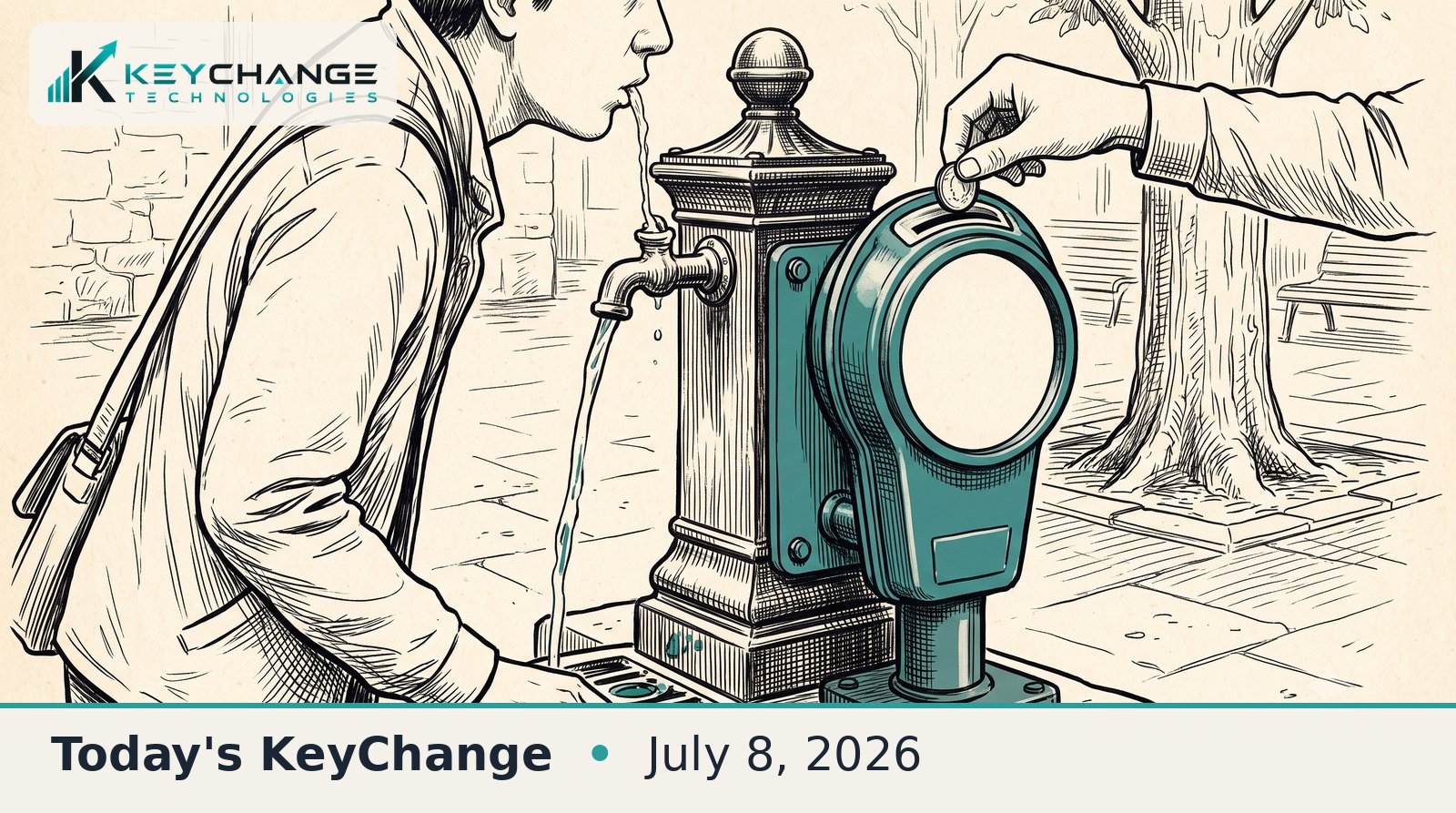
Your no-spin AI and IT news roundup for July 8, 2026. Today is mostly about the price of AI: the model you were using for free now runs a meter, the biggest software company on earth is quietly building its own models to stop paying the labs, and Google's next flagship is still stuck in the shop. On the security side, a perfect-10 ColdFusion bug is being hit in the wild, Accenture is cleaning up after a source-code theft claim, and Gitea servers are getting probed. Here is what actually matters for your business.
📌 The AI and IT news at a glance
- 💸 Claude Fable 5 leaves subscriptions for pay-per-use credits, though Anthropic blinked and extended access to July 12.
- 🏭 Microsoft starts replacing OpenAI and Anthropic with its own MAI models inside Excel and Outlook to cut its AI bill.
- ⏳ Google's Gemini 3.5 Pro slips again, now reportedly targeting July 17 after a ground-up rebuild.
- 🚨 A max-severity Adobe ColdFusion flaw (CVE-2026-48282) is under active attack with a July 10 federal patch deadline.
- 🕳️ Accenture confirms a breach after a hacker claimed to be selling 35GB of its source code and cloud keys.
- ⚖️ A judge approved 23andMe's $46.75M breach settlement over the 2023 hack that exposed roughly 7 million people.
- 🔓 A critical Gitea flaw (CVE-2026-20896) is being probed, letting attackers bypass login with a single HTTP header.
- 🧰 OpenAI shifts ChatGPT's Office tools to token-based pricing and adds a GPT-5.5 Instant Mini fallback.
🔝 Top story: Claude Fable 5 goes pay-per-use
Anthropic's most powerful model, Fable 5, stopped drawing from normal Claude subscription limits and moved to metered "usage credits" this week. Through July 7, Fable 5 counted against your regular Pro, Max, Team, or Enterprise plan (capped at about half of your weekly allowance, no extra charge). Starting July 8, using it bills through pay-as-you-go credits at standard API rates: roughly
Then the backlash hit. After users pushed back hard, Anthropic extended subscription access to existing subscribers until July 12 and framed the whole change as temporary, saying Fable 5 will return to standard plans "once capacity allows." The real sting lands on heavy agentic work: casual chat might add a few dollars a day, but a single long Claude Code session can burn through millions of tokens, so an hour of intensive agent work can plausibly cost $5 to 0 in credits on top of what you already pay.
In short: As of July 8, Claude's top model Fable 5 costs extra usage credits instead of being included in your subscription, with a short grace period for existing subscribers through July 12.
What it means for your business: If your team leans on Fable 5 for coding or agent workflows, your AI costs just became variable and potentially large, so turn on usage caps and watch the meter before the next invoice surprises you.
My take: This is the AI pricing model quietly growing up, and not in a fun way. "Unlimited-ish for one price" was always going to give way to metered billing on the frontier models, because the compute genuinely costs that much. The temporary framing is a face-saver, but the direction is clear: budget for AI like you budget for cloud, with alerts and caps, because the days of a flat monthly fee covering your heaviest usage are ending.
Source: Claude Fable 5 Usage Credits: What Changes After July 7, 2026 (Codersera)
🤖 AI
Microsoft starts swapping OpenAI and Anthropic for its own models
Bloomberg reported on July 7 that Microsoft has begun quietly replacing OpenAI and Anthropic models with its own in-house "MAI" models inside widely used apps like Excel and Outlook. Tens of thousands of AI prompts a week in those products are now being handled by Microsoft's own models rather than the outside labs it has leaned on. AI chief Mustafa Suleyman has been open about the motive: Microsoft wants to stop paying whatever the leading labs decide to charge, and building competitive models in-house is how it plans to control that cost.
This is not a clean break. MAI still handles only a small slice of overall AI usage, and Microsoft says it will keep using OpenAI for frontier work and other providers when they are the better tool. But the trend line is the story: the company that helped make OpenAI a household name is actively engineering its way out of total dependence on it.
In short: Microsoft is now running some Excel and Outlook AI features on its own MAI models instead of OpenAI and Anthropic to lower costs.
What it means for your business: The AI you use inside Microsoft 365 may increasingly be Microsoft's own model, which can shift quality, tone, and behavior under the hood even when the button you click looks the same.
My take: Every big buyer of AI is doing some version of this math, just with fewer resources than Microsoft. The lesson for a smaller company is not "build your own model," it is "do not hard-wire your business to a single provider." Keep your prompts and workflows portable enough that you can switch models when price or quality shifts, because even Microsoft is refusing to be locked in.
Source: Microsoft Replaces OpenAI, Anthropic With Own AI in Some Apps (Bloomberg)
Google's Gemini 3.5 Pro slips again, now eyeing July 17
Google's next flagship, Gemini 3.5 Pro, is still not out. Reporting this week says Google scrapped the existing Gemini 2.5 Pro architecture and is rebuilding the model from the ground up, with a new target date around July 17. The promised upgrades are ambitious: a 2 million token context window, a "Deep Think" reasoning layer, and better math and image generation to keep pace with OpenAI's GPT-5.6 and Anthropic's Fable 5. Worth a caveat: July 17 is a widely reported target, not a date Google has locked in with a model card, pricing, or documentation.
In short: Gemini 3.5 Pro remains delayed after an architectural rebuild, with July 17 floated as the next target but not officially confirmed.
What it means for your business: If you were holding a project for Gemini 3.5 Pro, keep holding loosely, because the date is soft and shipping today on a model that already exists usually beats waiting on one that keeps slipping.
My take: Delays like this are actually a decent sign that Google would rather ship something solid than rush a flagship to hit a calendar. But for planning purposes, treat unreleased models as vaporware until there is a model card and a price. Build with what is shipping now.
Source: Gemini 3.5 Pro Targets July 17 as DeepSeek's July 24 Deadline Hits Developers Now (TechTimes)
🛡️ IT and security
A perfect-10 Adobe ColdFusion flaw is under active attack
Attackers are now exploiting CVE-2026-48282, a maximum-severity (CVSS 10.0) vulnerability in Adobe ColdFusion, in the wild. The bug is a path-traversal flaw in the Remote Development Services (RDS) FILEIO handler that can lead to remote code execution without any authentication. Adobe patched it on June 30, and exploitation attempts showed up within hours of researchers publishing technical details. CISA has added it to its Known Exploited Vulnerabilities catalog and ordered federal civilian agencies to patch by July 10.
There is one mitigating detail: to be exploitable, a server has to have RDS enabled and its authentication disabled, which is not the default. Still, misconfigured or legacy ColdFusion boxes are exactly the kind of forgotten server that gets popped. The fix is to upgrade to ColdFusion 2025 Update 10 or 2023 Update 21.
In short: A maximum-severity ColdFusion flaw (CVE-2026-48282) allowing unauthenticated code execution is being actively exploited, with a July 10 federal patch deadline.
What it means for your business: If you run ColdFusion anywhere, patch it now and confirm RDS is off, because unauthenticated remote code execution is about as bad as a web-server bug gets.
My take: The pattern here is the real headline: public technical write-up, then exploitation within hours. Your patch window for critical internet-facing bugs is no longer days, it is the same afternoon. If you cannot patch that fast, you need something in front of the server (a WAF rule, an IP allowlist) that buys you time.
Source: Attackers exploit critical Adobe ColdFusion vulnerability (CVE-2026-48282) (Help Net Security)
Accenture confirms a breach after a 35GB source-code theft claim
Consulting giant Accenture confirmed a security incident this week after a threat actor using the handle "888" advertised what they claimed was just over 35GB of Accenture source code for sale on a cybercrime forum. Beyond source code, the seller claimed to have RSA and SSH keys, Azure personal access tokens, Azure Storage access keys, and configuration files, and posted a screenshot appearing to show them cloning an Azure DevOps repository hosted on an Accenture domain. The listing was a one-time sale payable only in Monero.
Accenture told reporters it is "aware of this isolated matter" and has "remediated its source," but did not confirm the attacker's claims about how much data was taken or exfiltrated. The same actor previously tried to sell Accenture employee data tied to a 2024 third-party breach, and Accenture was hit by LockBit ransomware back in 2021.
In short: Accenture confirmed a breach after a hacker claimed to be selling 35GB of its source code and cloud credentials, while disputing the specifics.
What it means for your business: Leaked cloud keys and access tokens are the real danger here, so if you share any pipeline, repo, or cloud tenant with a big vendor, rotate shared secrets and watch for unusual access.
My take: "We remediated the source" is corporate for "we found the hole and closed it," which is good, but it says nothing about what already walked out the door. The reusable lesson is boring and vital: secrets do not belong in source code or repo configs. If a stolen 35GB dump contains live keys, the breach keeps giving long after the repo is locked down.
Source: Accenture acknowledges security incident following 35GB data theft claim (Help Net Security)
A judge approves 23andMe's $46.75M breach settlement
A U.S. bankruptcy judge approved a $46.75 million settlement on July 7 resolving the class-action fallout from 23andMe's 2023 data breach. That breach, which ran from April to September 2023, used credential stuffing (attackers reusing passwords leaked from other sites) to break into accounts and ultimately expose the genetic and personal data of roughly 7 million customers. The approval lets the now-bankrupt company move forward with compensating affected users.
In short: A bankruptcy judge approved a $46.75M settlement over 23andMe's 2023 credential-stuffing breach that exposed about 7 million people's data.
What it means for your business: Credential stuffing works because customers reuse passwords, so enforcing multi-factor authentication on your accounts is the single cheapest way to avoid becoming the next settlement headline.
My take: The through-line from 2023 to a 2026 bankruptcy court is a long, expensive reminder that a breach is not a one-time event, it is a liability that follows you for years. And note what let the attackers in: not some exotic zero-day, just reused passwords. MFA everywhere is not paranoia, it is the floor.
Source: 23andMe Data Breach Settlement Approved by Bankruptcy Judge for $46.75 Million (Mirror Review)
A critical Gitea flaw is getting probed in the wild
Attackers have started probing for CVE-2026-20896, a critical (CVSS 9.8) authentication-bypass flaw in Gitea, the self-hosted Git service. The bug lets an attacker bypass login with a single crafted HTTP header, because Gitea Docker images before version 1.26.3 shipped with reverse-proxy authentication that trusted connections from any source IP instead of enforcing an allowlist. Successful exploitation exposes private repositories and any secrets stored in them. The flaw was patched on June 21, and probing began roughly 13 days later.
In short: A critical Gitea authentication-bypass flaw (CVE-2026-20896) exploitable via one HTTP header is now being probed, exposing private repos and secrets.
What it means for your business: If you self-host Gitea in Docker, update to 1.26.3 or later immediately and lock down which IPs can reach it, because your source code and stored secrets are the prize.
My take: This one is a gift-wrapped example of insecure defaults. The software trusted whoever showed up unless you told it not to, and plenty of teams never changed the default. When you stand up any self-hosted tool, assume the out-of-box config is convenient, not safe, and tighten access before it faces the internet.
Source: Critical Gitea Flaw Under Active Exploitation, Researchers Warn (SecurityWeek)
🧰 New tooling for business AI use
OpenAI moves ChatGPT's Office tools to token-based pricing
OpenAI's latest release notes shift how its ChatGPT tools for Microsoft Office are billed. ChatGPT for Excel/Sheets tasks and Workspace Agent runs now use token-based credit pricing for Enterprise and Edu workspaces, charged on input, cached input, and output tokens rather than a flat per-run credit. ChatGPT for PowerPoint stays free for Enterprise customers through August 6, 2026, after which it moves to the same token-based model. OpenAI also rolled out GPT-5.5 Instant Mini as a new fallback model with better intent tracking and fewer factual slips.
In short: OpenAI switched ChatGPT's Excel, Sheets, and Workspace Agent tools to token-based pricing for Enterprise and added a GPT-5.5 Instant Mini fallback.
What it means for your business: If your org uses ChatGPT's Office integrations, your costs now scale with how much you actually run, so heavy spreadsheet or agent users should model the new per-token math before it lands on the bill.
My take: Notice the theme of the whole day: Anthropic, and now OpenAI, both moving Office and agent features to per-token billing in the same week. Metered AI is becoming the norm across vendors, not a quirk of one. The winners will be teams that actually track their token usage instead of treating AI as an all-you-can-eat flat fee.
Source: OpenAI Release Notes, July 2026 (Releasebot)
That is the AI and IT news for July 8, 2026. For yesterday's roundup, including Anthropic's