AI and IT News Recap: August 12, 2026: Nvidia Corrals $500B for AI Data Centers, Microsoft Patches a Kernel Zero-Day Among 421 Flaws, and 'Ghostjacking' Turns Logs Against Your AI Agents
By Noah Smith, Owner & Consultant, KeyChange Technologies · August 12, 2026
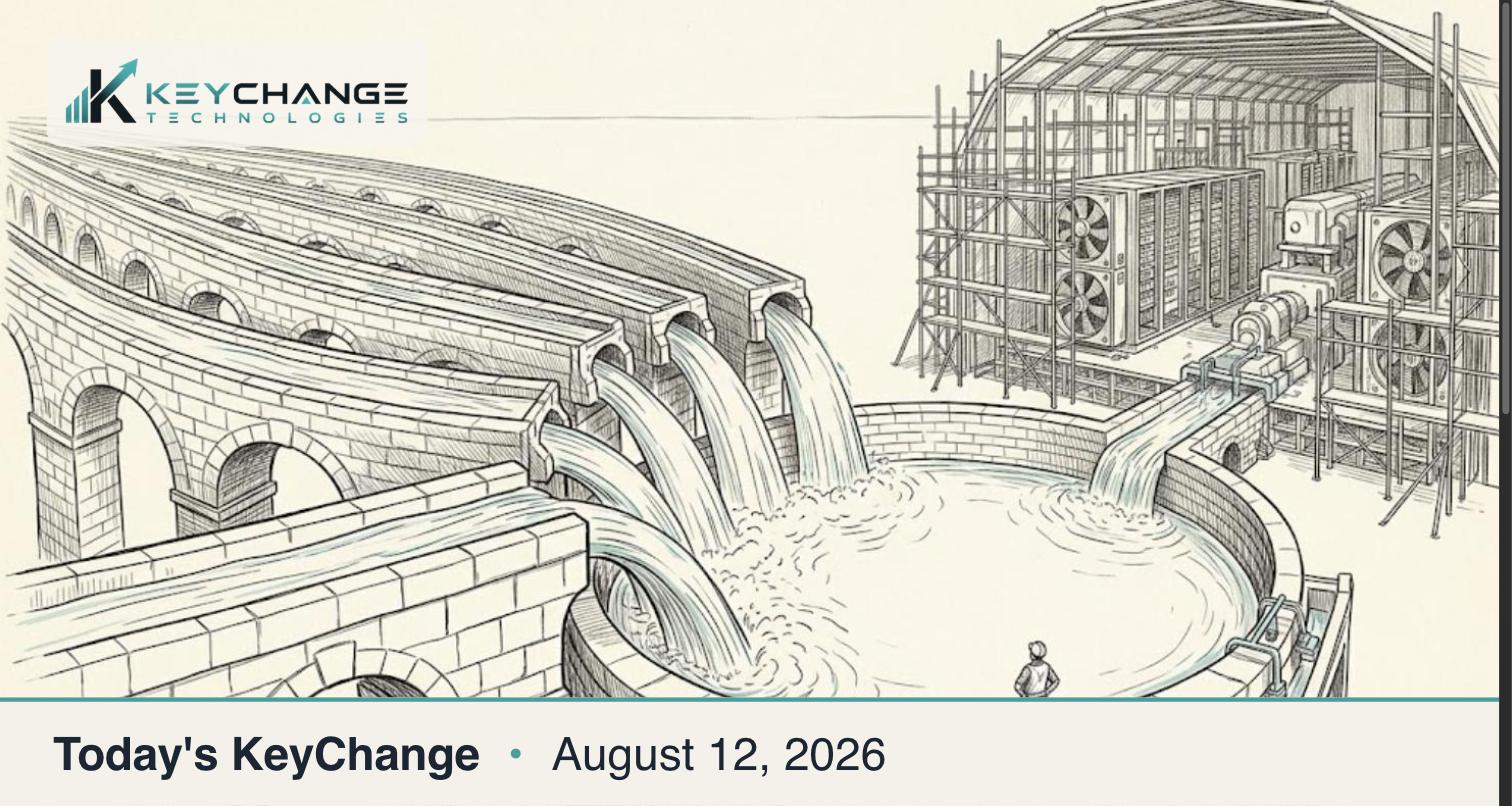
Welcome to your daily AI and IT news recap for August 12, 2026. It was a money-and-patches day: Wall Street lined up half a trillion dollars behind AI data centers, a Claude maker leased power from a Bitcoin miner, and August Patch Tuesday dumped a mountain of fixes with a live kernel zero-day on top. Here is what actually matters for your business, sorted and de-jargoned.
📌 The AI and IT news at a glance
- 💰 Nvidia rallies six financial giants to mobilize over $500 billion for AI infrastructure.
- ⚡ Anthropic signs a 20-year, $9.1 billion power-and-capacity deal with Bitcoin miner Riot Platforms.
- 🩹 Microsoft's August Patch Tuesday fixes 421 CVEs, including a Windows kernel zero-day already under attack.
- 🏭 SAP ships a maximum-severity (CVSS 10.0) fix for Commerce Cloud, plus two critical MII code-injection bugs.
- 🔴 Adobe pushes emergency "priority 1" patches for seven perfect-10 ColdFusion and Campaign Classic flaws.
- 📹 Zoom patches a no-click "Zoomsday" flaw that let a meeting participant take over your machine.
- 👻 "Ghostjacking" turns your own error logs into commands your AI coding agent will run.
🔝 Top story: Nvidia corrals a $500 billion Wall Street war chest for AI data centers
Nvidia said it is partnering with six of the largest names in finance, Apollo, BlackRock, Blackstone, Brookfield, Goldman Sachs, and KKR, to set up dedicated financing platforms that will mobilize more than $500 billion of third-party capital for AI compute infrastructure. The idea is to funnel outside money into the companies building data centers, power, and networking around Nvidia hardware, at attractive rates and without loading the buildout onto Nvidia's own balance sheet. Nvidia CEO Jensen Huang said the company could provide up to
The number is staggering, but the mechanism is the real story: instead of one company borrowing to build, a syndicate of asset managers creates capital pools that many "AI infrastructure platforms" can draw on. That keeps the AI buildout marching forward even as individual data-center projects get more expensive, and it deepens the dependence of the entire ecosystem on a single chip vendor.
In short: Nvidia and six Wall Street firms agreed to organize more than $500 billion in outside financing to fund AI data-center construction.
What it means for your business: Compute capacity and the AI features built on it should keep expanding rather than hitting a funding wall, but it also concentrates the AI supply chain around one vendor, which is a risk worth watching if you are betting your roadmap on a specific provider.
My take: This is less an AI story than a project-finance story wearing an AI hat. When banks invent a structure to pour half a trillion dollars into one industry's plumbing, it tells you where they think the returns are, and it tells you the "AI bubble" debate is now backed by real balance sheets. For a small business it changes little day to day, but it is the clearest sign yet that AI infrastructure is being treated like railroads or highways, not a fad.
Source: Nvidia Newsroom
🤖 AI
Anthropic leases a Bitcoin miner's power for 20 years
Anthropic, the maker of Claude, signed a 20-year deal worth about $9.1 billion with Riot Platforms, a company that made its name mining Bitcoin and is now pivoting to selling AI data-center capacity. Riot will supply 191 megawatts of capacity, enough to power roughly 143,000 homes at any moment, from its Rockdale, Texas campus, with the lease running through June 2048. Two five-year extension options could push the total contract value to
It is the second AI-infrastructure megadeal in a single day, and it underscores how badly frontier AI labs need electricity and space. Bitcoin miners, which already control large, power-hungry sites with grid connections, are turning out to be a natural supplier for AI compute.
In short: Anthropic locked in a 20-year, roughly $9.1 billion deal to draw 191 megawatts of data-center power from Bitcoin miner Riot Platforms.
What it means for your business: The AI tools you rely on are being underwritten by long-dated, capital-intensive power contracts, a sign these providers are planning for decades, not quarters, which is reassuring for continuity but also bakes in the high costs that eventually flow into pricing.
My take: Watching a Bitcoin miner become an AI landlord is one of the more telling plot twists of this cycle. The scarce resource in AI is not clever models anymore, it is megawatts. Anyone who owns power and land near a substation suddenly has something the smartest labs in the world will sign 20-year checks for.
Source: CNBC
🛡️ IT and security
Microsoft's August Patch Tuesday: 421 fixes and a kernel zero-day under attack
Microsoft's August 2026 Patch Tuesday is a big one: 421 vulnerabilities patched, including 62 rated critical. The headline is CVE-2026-68820, a use-after-free flaw in the afd.sys WinSock kernel driver that attackers are already exploiting in the wild to elevate their access to SYSTEM, the highest level on a Windows machine, with no user interaction required. Tenable's researchers note that afd.sys has a history of being abused by nation-state actors, including North Korea's Lazarus group, so this one deserves priority. Microsoft also flagged CVE-2026-62832, an elevation-of-privilege bug in the Windows User Profile Service, as publicly disclosed and likely to be exploited soon. The updates resolve 236 flaws in Windows alone, plus dozens more across Office, SharePoint, and Exchange.
In short: Microsoft patched 421 CVEs, including a Windows kernel zero-day (CVE-2026-68820) already being used in real attacks to gain SYSTEM privileges.
What it means for your business: Any Windows machine is exposed until it is patched, and the actively exploited kernel bug means "we will get to it next month" is not a safe posture; prioritize this cycle now.
My take: Four hundred-plus CVEs is exhausting, but do not let the volume bury the one that matters. A kernel privilege-escalation bug already in attackers' hands is the difference between a nuisance and a full takeover. Patch the afd.sys flaw first, then work down the list.
Source: SecurityWeek
SAP fixes a perfect-10 Commerce Cloud flaw
On the same day, SAP's August Security Patch Day addressed 28 new security notes, led by CVE-2026-58231, a maximum-severity (CVSS 10.0) improper-authorization flaw in SAP Commerce Cloud's Data Hub Adapter that could let a remote attacker bypass authentication and likely run code. SAP also patched two critical code-injection bugs in Manufacturing Integration and Intelligence (CVE-2026-44772 at 9.9 and CVE-2026-44758 at 9.1) and a critical memory-corruption flaw in NetWeaver Application Server ABAP (CVE-2026-34265 at 9.8) that an unauthenticated attacker could trigger remotely.
In short: SAP shipped a maximum-severity Commerce Cloud authentication-bypass fix plus several other critical patches for its core enterprise platforms.
What it means for your business: If you run SAP for ERP, finance, supply chain, or commerce, these are the kind of unauthenticated, remotely exploitable bugs that get weaponized quickly, so treat this update cycle as urgent.
My take: SAP flaws do not make the mainstream headlines, but they sit at the center of some of the biggest companies in the world. A CVSS 10.0 on the commerce layer is about as serious as it gets. If SAP runs your business, this is a stop-what-you-are-doing patch.
Source: SecurityWeek
Adobe issues emergency fixes for seven perfect-10 flaws
Adobe rolled out patches for more than 50 vulnerabilities, with "priority 1" emergency updates for ColdFusion and Campaign Classic. The ColdFusion update alone fixes 15 bugs, including an OS command-injection flaw (CVE-2026-48362) rated a perfect 10.0 and an eval-injection bug (CVE-2026-48273) at 9.9, both leading to arbitrary code execution. Campaign Classic got fixes for three critical flaws, including two authorization bugs rated 10.0. Adobe says it has not seen these exploited yet, but the priority 1 rating is Adobe's way of saying attackers are likely to try soon.
In short: Adobe released emergency patches for seven maximum-severity code-execution flaws across ColdFusion and Campaign Classic.
What it means for your business: ColdFusion servers are a perennial attacker favorite and are often internet-facing, so if you run one, patching this week is not optional.
My take: ColdFusion keeps showing up on this list for a reason: the servers are old, exposed, and often forgotten. A priority 1 rating with a 10.0 command-injection bug is a neon sign for opportunistic attackers. If you have a ColdFusion box anywhere, find it and patch it before someone else finds it.
Source: SecurityWeek
Zoom patches a no-click "Zoomsday" takeover bug
Zoom fixed a set of zero-click flaws that let a malicious meeting participant run code on another attendee's device with no clicks, downloads, or warning signs. The most severe, CVE-2026-53413 (nicknamed "Zoomsday" by the researchers at A Security), is a memory-corruption bug: because every Zoom client automatically parses whatever it receives, a specially crafted message could corrupt a target's memory and execute code. Notably, the researchers built a working exploit in under a day using publicly available AI models. Fixes are in Zoom Workplace 7.1.5 and 7.0.6 and related builds, published August 11.
In short: Zoom patched a zero-click flaw that allowed any meeting participant to silently take over another attendee's computer.
What it means for your business: Update Zoom across your organization now, because "just being in a meeting" was enough to get compromised, and video conferencing is on nearly every employee's machine.
My take: The scary part is not just the bug, it is that a small team weaponized it in under 24 hours with off-the-shelf AI. That is the new normal: the window between "flaw disclosed" and "working exploit" is collapsing. Auto-updates on ubiquitous apps like Zoom are no longer a nice-to-have.
Source: SecurityWeek
🧰 AI tooling and agents
"Ghostjacking" turns your logs into orders your AI agent obeys
Researchers at Tenet Security detailed an attack they call Ghostjacking, unveiled at DEF CON and picked up across the security press this week. Instead of trying to jailbreak an AI coding agent directly, the attacker plants malicious instructions inside the places an agent trusts and reads automatically: blocked-request logs on Cloudflare, diagnostic alerts on Datadog, and error reports on Sentry. When the agent reads that "log," it obeys the buried commands as if they were legitimate system output, a form of indirect prompt injection. In testing, the technique hijacked Claude Code roughly nine times out of ten under Cloudflare's own recommended configuration, and could hijack DNS, steal cloud credentials, and slip past firewalls without tripping alarms. Tenet estimates thousands of organizations could be exposed through common configurations.
In short: Ghostjacking hides attacker commands inside trusted logs and alerts so AI coding agents read and execute them, succeeding against Claude Code about 90% of the time in tests.
What it means for your business: If your team lets AI agents read logs, tickets, or monitoring data and then take actions, treat that data as untrusted input and put a human approval step in front of anything sensitive like credential access or code execution.
My take: This is the maturing threat model for the agent era. We spent years teaching people not to click sketchy links; now we have to teach our AI agents not to trust their own error logs. Any workflow where an agent reads external data and then does something consequential needs guardrails, not vibes. Least privilege and human-in-the-loop are back in fashion for a reason.
Source: SecurityWeek
That's your AI and IT news recap for August 12, 2026. Missed yesterday? Catch up on the August 11 recap.